DALK
DALK
Deep anterior lamellar keratoplasty
On this page
The cornea’s remarkable transparency and precise curvature are essential for clear vision. Certain conditions, often affecting the outer and middle layers, can lead to opacity, structural instability or irregular shape, severely impairing sight. When such problems require a transplant but the vital innermost layer — the endothelium — remains healthy, deep anterior lamellar keratoplasty offers a highly selective and effective solution.
DALK represents a significant advance over traditional full-thickness corneal transplantation, allowing a more targeted approach when only the anterior and stromal layers are diseased.
Understanding DALK
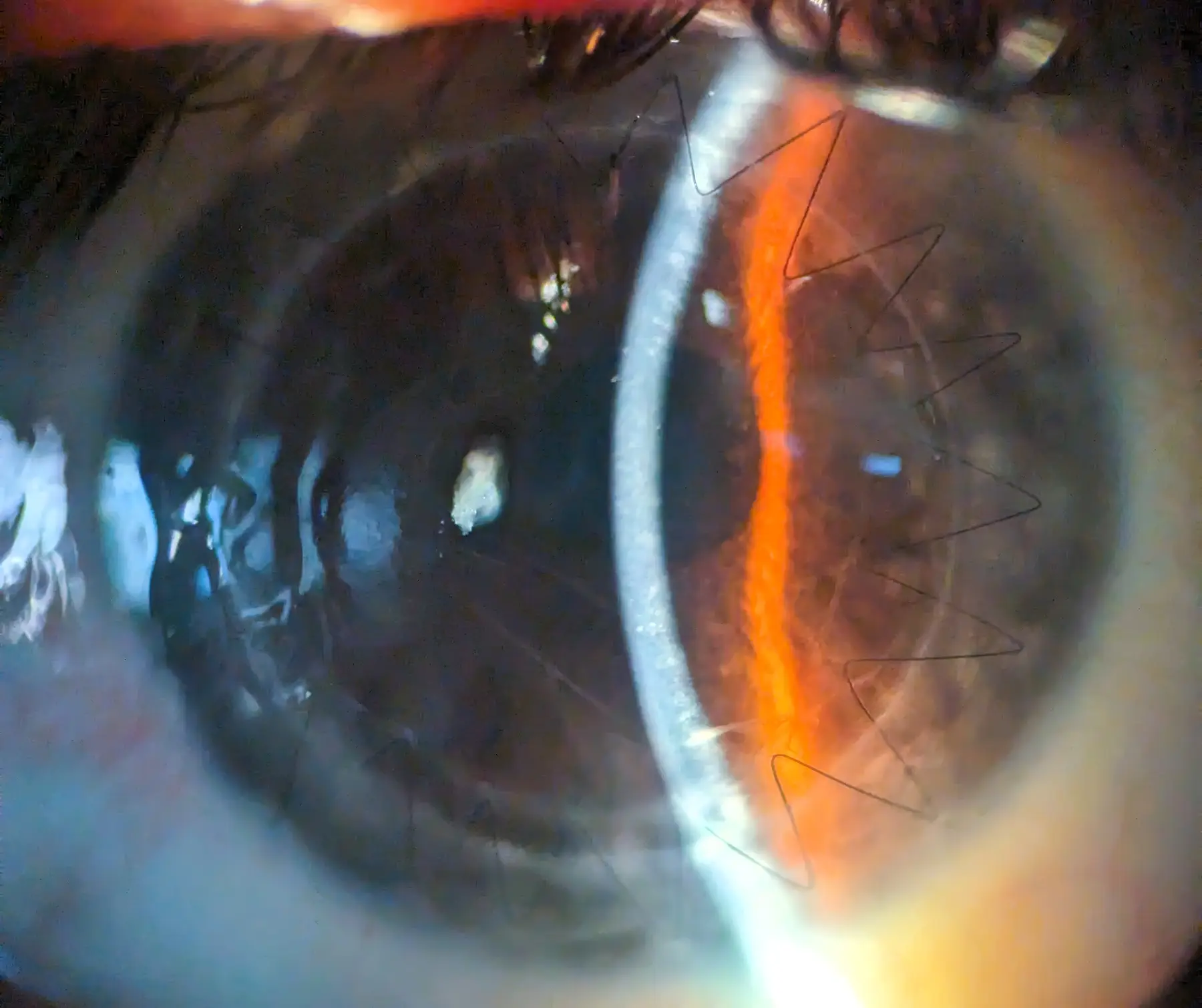
DALK is a partial-thickness corneal transplant designed to replace the diseased or scarred anterior layers of the cornea while preserving the patient’s own healthy Descemet’s membrane and endothelial cell layer. The surgical process involves carefully removing the affected corneal stroma, leaving behind a thin, smooth layer of the patient’s posterior cornea. A corresponding anterior lamellar donor graft, prepared from a donor cornea, is then precisely sutured into place.
The procedure often uses a technique known as the big bubble, in which air or fluid is injected to separate the diseased stromal layers from Descemet’s membrane, creating an ideal plane for the transplant.
Key indications
DALK is particularly well suited to conditions where the primary pathology lies in the anterior cornea and the endothelium is healthy and functional. Common indications include:
- Keratoconus. This progressive condition, characterised by corneal thinning and cone-like protrusion, is the most frequent indication for DALK. When glasses or contact lenses no longer provide adequate vision and the endothelium is intact, DALK is a superior option to a full-thickness graft.
- Corneal scarring from infection (bacterial, fungal or viral keratitis), trauma or prior surgery, provided the scarring does not extend to or severely compromise the endothelium.
- Certain corneal dystrophies — granular, lattice or macular — where the opacities are primarily stromal and the endothelium is preserved.
Advantages over full-thickness transplantation
The benefits stem primarily from preserving the patient’s own endothelium.
- Significantly reduced risk of endothelial rejection. Because the patient’s own endothelial cells are retained, the most common and severe form of graft rejection is largely avoided. This often translates into less intensive long-term anti-rejection medication.
- Enhanced structural integrity. The patient’s intact Descemet’s membrane provides a strong natural barrier, resulting in a more structurally robust eye after surgery, with lower risk of rupture from future trauma than a full-thickness graft.
- Long-term graft survival. By eliminating the risk of endothelial cell loss from rejection, DALK grafts have the potential for longer functional survival.
- Better eye bank utilisation. The anterior donor tissue can be used for DALK while the posterior tissue may be used for a DMEK procedure in another patient.
Surgical considerations and recovery
While the concept of DALK is elegant, the procedure is technically demanding — particularly the precise separation of the corneal layers — and requires significant surgical skill and experience.
As with penetrating keratoplasty, visual recovery after DALK is gradual. Some initial improvement may be noted early, but optimal vision often takes several months to a year as the graft integrates and sutures are managed or removed. Astigmatism can still be a factor, since sutures are used to secure the graft, but it may be more predictable than after a full-thickness transplant.
DALK has transformed the treatment of anterior corneal disease, especially keratoconus. By offering a more conservative and biologically favourable approach, it allows patients to benefit from corneal transplantation while mitigating some of the significant long-term risks associated with full-thickness grafts.
Sources
Updated: